market-data-sanity-checker - v1.2.0
market-data-sanity-checker







Trust layer for market data. Validate, score and explain anomalies in OHLCV, dividends, splits and fundamentals — before they break your screener, dashboard or tracker.
- Quickstart
- Why this exists
- Install
- Usage
- The sanity score
- Rule catalog
- When NOT to use it
- FAQ
- Development & contributing
Data quality / validation for market data, as a library and CLI. Not another generic data validator: this tool understands the semantics of financial data — corporate actions, adjustments, currencies, exchanges — and tells you what is suspicious, why, what impact it has, and whether to block, flag or review the datum.
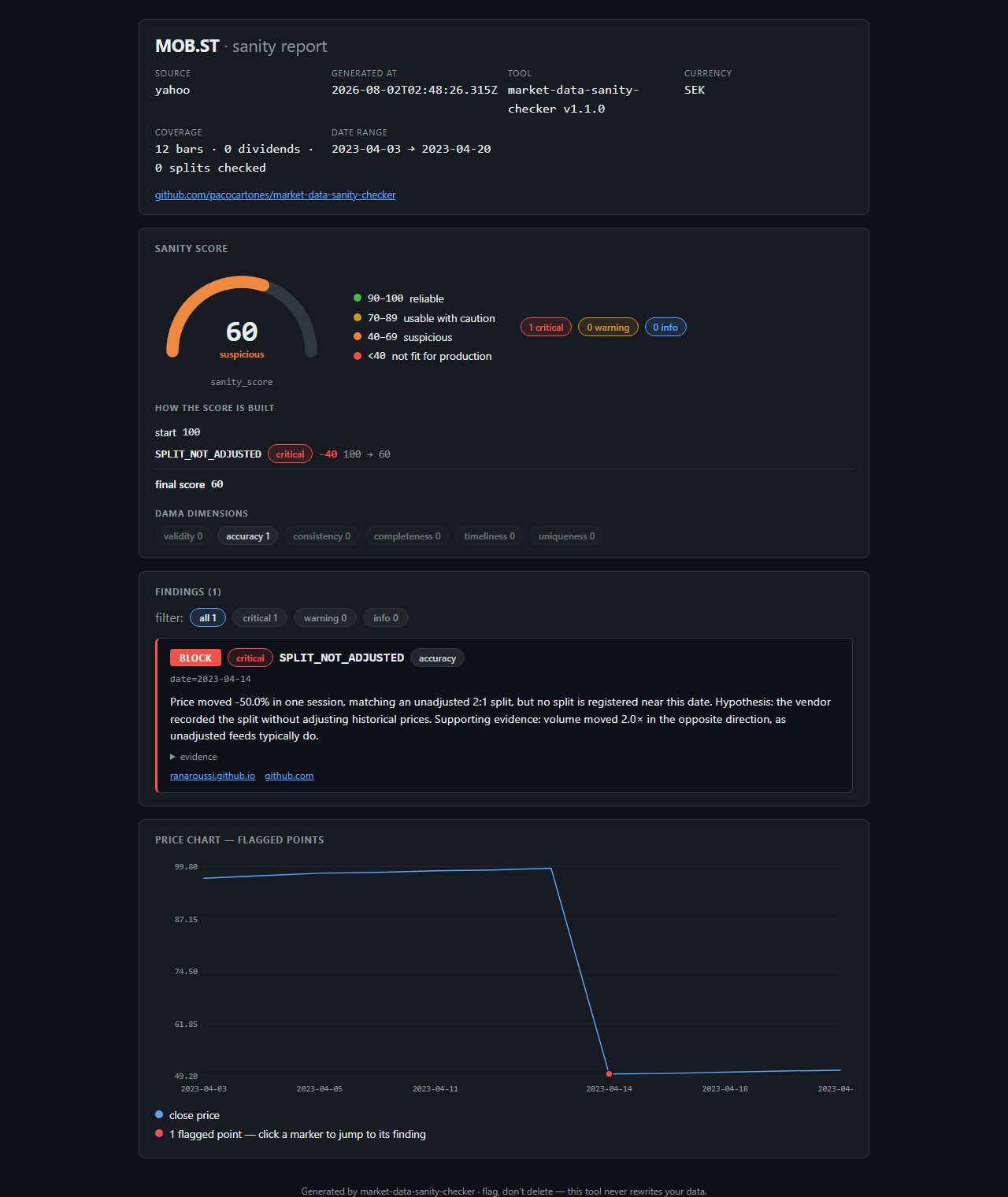
A real mdsc check on MOB.ST: the phantom −50% "crash" is an unadjusted 2:1 split —
detected, scored, and explained with the volume evidence. One self-contained .html file —
works offline, interactive chart, no server.
Quickstart (30 seconds)
No install, no API key — audit a live symbol straight from Yahoo Finance:
npx market-data-sanity-checker check --provider yahoo --symbol AAPL
AAPL (yahoo) — sanity_score: 95/100
findings: 0 critical · 0 warning · 1 info
Or point it at your own data (CSV/JSON — headers are auto-mapped) and get the interactive HTML dashboard:
npx market-data-sanity-checker check --file your-data.csv --html report.html
That's the whole loop: score (0–100), findings (what's suspicious, why, with
evidence), action (block / flag / review). See docs/examples.md
for real caught-in-the-wild cases — the phantom −50% split crash, the $185 Berkshire tick,
pence/pounds ×100 — each reproducible from the shipped fixtures.
Why this exists
Market data is wrong more often than you think:
- June 3, 2024 — a SIP software bug showed Berkshire Hathaway (BRK.A) at $185 instead of ~$621,000 (−99.9%). Trades executed on the bad price cost Interactive Brokers $48M.
- July 3, 2017 — Nasdaq test data propagated to Google Finance, Bloomberg and Yahoo, showing AAPL, GOOG and MSFT all at $123.47.
- Yahoo Finance regularly ships unadjusted splits that look like −50% crashes, dividends scaled 100× (the classic LSE pence/pounds confusion), and duplicated dividends.
- Tickers get reused (
ABhas named 6 different companies), silently splicing two firms into one price series.
Generic data quality tools (Great Expectations, Soda, Pandera) check structure — nulls,
ranges, schemas. Data vendors (yfinance, ccxt) fetch data but don't audit it. Nothing open
source sits in between. mdsc is that missing layer.
Principles
- Causal explanation, not binary checks. Every finding carries a hypothesis ("possible unadjusted 2:1 split"), the evidence behind it, and a recommended action.
- Flag, don't delete. This tool never rewrites your data. It detects, explains and scores — the decision stays with you.
- Conservative thresholds. Every threshold comes with a citation (academic literature or a documented real-world incident) and is configurable. False negatives are acceptable; false positives destroy trust.
- Provider-agnostic. The core works on CSV/JSON with a canonical internal schema. Provider connectors are plugins, never core.
Install
npm install market-data-sanity-checker # or: pnpm add market-data-sanity-checker
Usage
CLI
# check a CSV of OHLCV bars (date,open,high,low,close,volume — headers are auto-mapped)
mdsc check --file aapl.csv --symbol AAPL --source yahoo
# fetch and check straight from a provider (no API key needed for Yahoo)
mdsc check --provider yahoo --symbol AAPL --range 1y
# compare two sources for the same symbol
mdsc compare --symbol AAPL --providers yahoo,alpha-vantage
mdsc compare --files yahoo-aapl.json,stooq-aapl.csv
# (PowerShell: quote values with commas — "yahoo,alpha-vantage" — or the shell swallows the comma)
# machine-readable report
mdsc check --file aapl.json --format json > report.json
# provider status and rule catalog
mdsc providers
mdsc rules
Exit codes: 0 gate passed · 1 gate failed (critical findings, or --fail-on/--min-score)
· 2 operational error (file unreadable, invalid flags, provider unavailable, invalid config).
Providers are plugins: yahoo works keyless; alpha-vantage needs the
ALPHA_VANTAGE_API_KEY env var (free key at alphavantage.co). New providers plug in via
the Connector contract (src/connectors/types.ts).
Configuration (mdsc.config.json)
Every threshold is project-tunable without touching code — drop a mdsc.config.json in
your working directory (or pass --config <path>). Unknown rule ids are a hard error
with the valid catalog:
{
"rules": {
"RETURN_SPIKE": { "params": { "zscoreThreshold": 5 } },
"STALE_PRICE": { "enabled": false },
"SPLIT_NOT_ADJUSTED": { "severity": "warning" }
},
"compareRules": {
"VOLUME_DIVERGENCE": { "enabled": false }
}
}
CI gating, history and dashboards
# gate your pipeline: exit 1 on warnings too, or when the score drops
mdsc check --provider yahoo --symbol AAPL --fail-on warning --min-score 80
# keep an audit trail and see the trend
mdsc check --provider yahoo --symbol AAPL --save
mdsc history --symbol AAPL
# self-contained HTML dashboard (offline, interactive — great CI artifact)
mdsc check --file aapl.csv --html report.html
SDK
import { ingestFile, marketDataSetSchema, checkMarketData } from 'market-data-sanity-checker'
const raw = await ingestFile('aapl.csv', { symbol: 'AAPL', source: 'yahoo' })
const dataset = marketDataSetSchema.parse(raw)
const report = checkMarketData(dataset)
console.log(report.sanity_score) // 0–100
for (const finding of report.findings) {
console.log(finding.severity, finding.rule, finding.explanation)
}
Fetch and compare sources with the connector plugins:
import { yahoo, alphaVantage, compareDatasets } from 'market-data-sanity-checker'
const a = await yahoo.fetchDaily('AAPL', { range: '1y' })
const b = await alphaVantage.fetchDaily('AAPL') // needs ALPHA_VANTAGE_API_KEY
const comparison = compareDatasets(a, b)
console.log(comparison.consistency_score, comparison.compared_dates)
Every threshold is a parameter — rules can be tuned, re-severitized or disabled:
const report = checkMarketData(dataset, {
rules: {
RETURN_SPIKE: { params: { zscoreThreshold: 5 } },
STALE_PRICE: { enabled: false },
SPLIT_NOT_ADJUSTED: { severity: 'warning' },
},
})
Report shape
{
"symbol": "MOB.ST",
"source": "yahoo",
"sanity_score": 60,
"findings": [
{
"rule": "SPLIT_NOT_ADJUSTED",
"severity": "critical",
"action": "block",
"dimension": "accuracy",
"where": { "date": "2023-04-14" },
"explanation": "Price moved -50.0% in one session, matching an unadjusted 2:1 split, but no split is registered near this date. Hypothesis: the vendor recorded the split without adjusting historical prices. Supporting evidence: volume moved 2.0× in the opposite direction, as unadjusted feeds typically do.",
"evidence": { "return": -0.5, "hypothesized_ratio": "2:1", "previous_close": 99.4, "close": 49.7, "volume_ratio": 2 },
"references": ["https://ranaroussi.github.io/yfinance/advanced/price_repair.html"],
"occurrences": 1
}
],
"summary": { "critical": 1, "warning": 0, "info": 0 },
"generated_at": "2026-07-31T17:00:00.000Z"
}
The sanity score
sanity_score = max(0, 100 − Σ penalties). Each finding penalizes by severity:
critical −40, warning −15, info −5. A rule penalizes once per dataset,
at its highest severity — 847 bars with the same defect must not drive the score below
zero; the finding carries occurrences instead.
| Score | Band |
|---|---|
| 90–100 | reliable |
| 70–89 | usable with caution |
| 40–69 | suspicious |
| <40 | not fit for production |
Rule catalog
The corpus ships 36 rules: 29 single-source across four blocks, plus 7 multi-source
compare rules. Full details with defaults and references: mdsc rules (or
--format json). Real-case fixtures anchor the headline rules:
tests/fixtures/, documented in docs/fixtures.md.
Price / OHLCV (13)
| Rule | Severity | What it catches |
|---|---|---|
SPLIT_NOT_ADJUSTED ⭐ |
critical | Price jump matching a split ratio with no split registered (phantom −50% "crashes") |
PRICE_SPIKE_INTRADAY |
critical | Isolated bad ticks: far outside the neighbourhood AND reverted next session (Berkshire 2024) |
PRICE_NONPOSITIVE |
critical | Zero/negative/NaN prices |
OHLC_INCONSISTENT |
critical | high < low, open/close outside [low, high] |
VOLUME_NEGATIVE |
critical | Negative or non-finite volume |
TS_DUPLICATED |
critical | Two bars for the same timestamp |
RETURN_SPIKE |
warning | Robust statistical outlier returns (modified z-score), deduplicated against splits |
CURRENCY_SCALE_SUSPECT |
warning | Persistent ~100× level shifts — pence/pounds (GBX/GBP) block confusion |
STALE_PRICE |
warning | Identical close for 3+ sessions with volume — frozen feed |
BAR_MISSING |
warning | Gaps of a full trading week or more |
TS_UNORDERED |
warning | Bars out of chronological order |
ZERO_VOLUME_MOVED |
warning | Zero volume but price moved intraday |
INSUFFICIENT_DATA |
warning | Too few bars to evaluate plausibility — the score reflects absence of evidence |
Corporate actions (9)
| Rule | Severity | What it catches |
|---|---|---|
EXDATE_AFTER_PAYDATE |
warning | Payment date preceding ex-date (field swap, unless a large special dividend mandates it) |
DIV_DUPLICATED |
warning | Same dividend recorded twice within days (ALC.SW 2023) |
EXDATE_MISPLACED |
warning | No price drop on the registered ex-date, matching drop days later (TETY.ST) |
DIV_NOT_ADJUSTED |
warning | Dividend registered but pre-ex-date prices unadjusted (8TRA.DE, 1398.HK) |
DIV_SCALE_100X |
warning | Single dividend implausibly large — ×100 pence/pounds error (HLCL.L, LTI.L) |
DIV_YIELD_IMPOSSIBLE |
warning | TTM dividend yield above the 20% plausibility bound |
DIV_SPECIAL_MISCLASSIFIED |
info | "Regular" dividend that is an extreme outlier vs the issuer's own history |
SPLIT_RATIO_IMPROBABLE |
warning / info | Split ratio extreme or 1:1; near-1 ratios flagged as probable spin-offs (info) |
CORPORATE_ACTION_MISSING_FROM_FACTOR |
warning | Prices adjusted (factor < 1) with no dividend/split registered to explain it |
Fundamentals (4)
| Rule | Severity | What it catches |
|---|---|---|
FUNDAMENTALS_SIGN_VALIDITY |
critical | marketCap or sharesOutstanding non-positive or non-finite |
MARKETCAP_MISMATCH |
warning | marketCap ≠ sharesOutstanding × price (Alphabet case) |
PE_EPS_INCOMPATIBLE |
warning | P/E incompatible with EPS and price |
PAYOUT_IMPOSSIBLE |
warning | Payout ratio negative or far above 300% of EPS (REIT-aware) |
Metadata (3)
| Rule | Severity | What it catches |
|---|---|---|
CURRENCY_SUSPECT |
warning / info | GBP label on pence-looking prices; currency absent (info) |
SYMBOL_MAPPING_SUSPECT |
warning | ISIN checksum invalid; ISIN country inconsistent with exchange (ticker reuse) |
DIVIDEND_FX_MISMATCH |
warning | Dividend currency differs from the series currency (Shell pays USD, trades GBX) |
Compare (multi-source, 7)
| Rule | Severity | What it catches |
|---|---|---|
SYMBOL_MISMATCH |
critical | The two datasets are for different symbols — comparison is meaningless |
INSUFFICIENT_OVERLAP |
warning | Too few shared dates between sources — agreement cannot be evaluated |
CLOSE_DIVERGENCE |
warning | Systematic close disagreement between two sources |
DIVIDEND_MISMATCH |
warning | Dividend missing or different in the other source |
SPLIT_MISMATCH |
warning | Split missing or with a different ratio in the other source (phantom-crash factory) |
PRICE_DATE_MISMATCH |
info | Specific dates where the sources disagree beyond tolerance |
VOLUME_DIVERGENCE |
info | Systematic volume disagreement (volumes are not cross-comparable) |
Findings carry rule, severity (critical/warning/info), action (block/flag/review),
dimension (DAMA data quality dimension), a human-readable explanation, evidence, and
references to the incident or literature justifying the rule.
When NOT to use it
- It does not repair data.
mdscflags, never rewrites — flag, don't delete. If you need automatic price repair (yfinance-style), do it downstream, on your own call. - It is not for realtime or tick data. The unit of analysis is the daily bar plus corporate actions; intraday streams and tick-level feeds are out of scope.
- It does not cover options or futures corporate actions. The semantics are modeled for equities/ETFs; derivative chains, rolls and expiries are not checked.
- It is not a substitute for paid point-in-time data. It catches vendor defects, but survivorship-bias-free, restatement-aware datasets remain a paid-vendor feature.
FAQ
Why does Yahoo Finance show −50% crashes that never happened — and does mdsc catch them?
Those are unadjusted splits: the vendor records the split but doesn't adjust historical
prices, so a 2:1 split looks like a −50% crash. SPLIT_NOT_ADJUSTED (critical) matches the
jump against plausible split ratios and cross-checks the volume signature; the compare rule
SPLIT_MISMATCH catches sources that disagree on the split itself.
What is the sanity_score?
A 0–100 quality score per dataset: max(0, 100 − Σ penalties) with −40/−15/−5 per
critical/warning/info finding, each rule penalizing once per dataset. 90+ reliable,
70–89 usable with caution, 40–69 suspicious, below 40 not fit for production. See
The sanity score.
Does mdsc fix my data?
No — flag, don't delete. It detects, explains and scores anomalies, and recommends an
action (block/flag/review); the decision and any repair stay with you.
Which data sources are supported?
Any CSV/JSON you can map to the canonical schema (mdsc check --file), Yahoo Finance
keyless (--provider yahoo), and Alpha Vantage with a free API key. New providers plug in
via the Connector contract.
Can I gate CI on data quality?
Yes: mdsc check --provider yahoo --symbol AAPL --fail-on warning --min-score 80 exits 1
when the gate fails (0 pass, 2 operational error) — drop it into any pipeline.
How is this different from Great Expectations or Pandera?
Those are generic, structure-first validators (nulls, ranges, schemas) you configure
yourself. mdsc is domain-first: it ships 36 rules that understand market-data semantics —
splits, dividends, pence/pounds, ticker reuse — each with a causal explanation, evidence,
a literature or incident reference, and a tunable severity, plus multi-source comparison.
Roadmap
- [x] Phase 0 — canonical schema, CSV/JSON ingestion, scoring model, CLI, CI
- [x] Phase 1 — OHLCV rules engine (12 rules: unadjusted splits, bad ticks, stale
prices, currency scale suspects…), per-rule config,
mdsc rules→ v0.1.0 - [x] Phase 2 — corporate actions, fundamentals and metadata (13 rules),
identifiersschema (ISIN/CUSIP/FIGI), golden report-contract tests → v0.2.0 - [x] Phase 3 — provider connectors (Yahoo keyless, Alpha Vantage), comparison engine
(
mdsc compare, 5 compare rules), provider scoreboard, real-data calibration → v0.3.0 - [x] Phase 4 —
mdsc.config.jsoncustom rules, CI gating (--fail-on/--min-score), audit history (mdsc history), self-contained HTML dashboards, OKF datapackage → v1.0.0 - [ ] Phase 5+ (if traction) — user rule plugins, hosted API, more connectors, web app
Provider scoreboard
The project audits itself against reality, publicly: scoreboard/ holds
the latest weekly audit of ~30 liquid symbols per provider (mean sanity score, worst
symbols, findings), regenerated every Monday by a GitHub Action and reproducible by
anyone with pnpm scoreboard. calibration/ holds the latest 50-symbol
calibration run — the corpus's honesty loop against real Yahoo data.
Development
pnpm install
pnpm test # vitest
pnpm typecheck # tsc --noEmit
pnpm lint # eslint
pnpm build # tsup → dist/
pnpm dev check --file tests/fixtures/ohlcv-valid.csv
Contributing
See CONTRIBUTING.md. The short version: every rule needs a stable ID, a severity, a documented real-world case or literature reference, and a fixture.